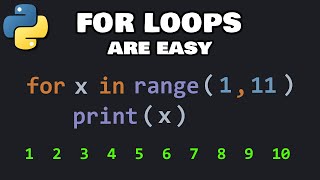
Web Reference: Mar 11, 2026 · Python for loops are used for iterating over sequences like lists, tuples, strings and ranges. A for loop allows you to apply the same operation to every item within the loop. Using a for loop avoids the need to manually manage the index. A for loop can iterate over any iterable object, such as a dictionary, list or custom iterator. Python For Loops A for loop is used for iterating over a sequence (that is either a list, a tuple, a dictionary, a set, or a string). This is less like the for keyword in other programming languages, and works more like an iterator method as found in other object-orientated programming languages. In Python, we use a for loop to iterate over various sequences, such as lists, tuples, sets, strings, or dictionaries. The for loop allows you to iterate through each element of a sequence and perform certain operations on it. In this tutorial, we will explore how to use the for loop in Python, with the help of examples.
YouTube Excerpt: python
Information Profile Overview
Python 101 For Loop - Latest Information & Updates 2026 Information & Biography
Details: $76M - $96M
Salary & Income Sources
Career Highlights & Achievements








Assets, Properties & Investments
This section covers known assets, real estate holdings, luxury vehicles, and investment portfolios. Data is compiled from public records, financial disclosures, and verified media reports.
Last Updated: April 2, 2026
Information Outlook & Future Earnings

Disclaimer: Disclaimer: Information provided here is based on publicly available data, media reports, and online sources. Actual details may vary.