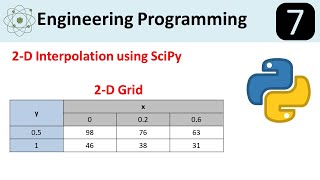
Web Reference: There are several general facilities available in SciPy for interpolation and smoothing for data in 1, 2, and higher dimensions. The choice of a specific interpolation routine depends on the data: whether it is one-dimensional, is given on a structured grid, or is unstructured. For the sake of explicitness, here is the code with which I generated the input data. While in this specific case I'm obviously aware of the function underlying the data, I will only use this to generate input for the interpolation methods. I use numpy for convenience (and mostly for generating the data), but scipy alone would suffice too. One-dimensional linear interpolation for monotonically increasing sample points. Returns the one-dimensional piecewise linear interpolant to a function with given discrete data points (xp, fp), evaluated at x.
YouTube Excerpt: This is a series of tutorials on Scientific Programming Using
Information Profile Overview
2d Interpolation In Python - Latest Information & Updates 2026 Information & Biography

Details: $31M - $46M
Salary & Income Sources

Career Highlights & Achievements


Assets, Properties & Investments
This section covers known assets, real estate holdings, luxury vehicles, and investment portfolios. Data is compiled from public records, financial disclosures, and verified media reports.
Last Updated: April 5, 2026
Information Outlook & Future Earnings
Disclaimer: Disclaimer: Information provided here is based on publicly available data, media reports, and online sources. Actual details may vary.